 The power of words is so strong that few people can
really command it. Yet, when it is done properly, these words have the power to
influence generations to come. Jane Austen is one such author that commanded this
power. Between novels like Pride and Prejudice or Emma, Austen left behind a trail of humor and social commentary that helped pave the way for nineteenth century realism.
The power of words is so strong that few people can
really command it. Yet, when it is done properly, these words have the power to
influence generations to come. Jane Austen is one such author that commanded this
power. Between novels like Pride and Prejudice or Emma, Austen left behind a trail of humor and social commentary that helped pave the way for nineteenth century realism.
Jane Austen was born in 1775, a time where unrest was
stirring across the world. At a young age her family took in one of her French
aristocratic cousins (who was also her future sister in law and possible
inspiration for her Mansfield Park character Mary Crawford) whose first husband,
the Comte de Feuillide, had been executed via guillotine. Events such as these
filled Austen with horror and greatly effected he writings, the darkest of
which is Northanger Abbey. Astonishingly, Austen never mentions politics
directly. Instead she paints a picture that shows how lives are effected by
outside influences (prejudices) and how these circumstances can be overlooked
for the greater good.
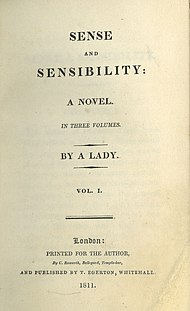 Much like the works of the great William Shakespeare,
Jane Austen’s novels are read and taught about in schools across the world. Her
works have also been adapted hundreds of times. Her first full-length novel was
entitled Elinor and Marianne, it would be published in 1811 under the title
Sense and Sensibility. While she was still living the majority of her works
would be published anonymously. No one can quite say why her works never had
her name on them until after her death, she never wrote down a reason. Yet, we
can speculate that her being a female had an influence on this decision. Many female
authors at this time, like the Bronte sisters, wrote either anonymously or under
male pseudonyms.
Much like the works of the great William Shakespeare,
Jane Austen’s novels are read and taught about in schools across the world. Her
works have also been adapted hundreds of times. Her first full-length novel was
entitled Elinor and Marianne, it would be published in 1811 under the title
Sense and Sensibility. While she was still living the majority of her works
would be published anonymously. No one can quite say why her works never had
her name on them until after her death, she never wrote down a reason. Yet, we
can speculate that her being a female had an influence on this decision. Many female
authors at this time, like the Bronte sisters, wrote either anonymously or under
male pseudonyms.  Many modern-day authors look to Austen for inspiration. It
is likely that the before mentioned Bronte sisters knew something of her
novels. These novels and their adaptations can be seen all over the place, most
notably of which is probably the 1995 adaption of Pride and Prejudice staring Colin
Firth as Mr. Darcy. Sense and Sensibility, Pride and Prejudice, Mansfield Park,
and Emma were all published before Jane Austen passed away in 1817. Her last
two creations, Persuasion and Northanger Abbey were made into a set by her
brother Henry who helped them to be published. As an honor to his sister he
would also have these works published, for the first time, under her real name.
Her books have been continuously in print since 1833.
Many modern-day authors look to Austen for inspiration. It
is likely that the before mentioned Bronte sisters knew something of her
novels. These novels and their adaptations can be seen all over the place, most
notably of which is probably the 1995 adaption of Pride and Prejudice staring Colin
Firth as Mr. Darcy. Sense and Sensibility, Pride and Prejudice, Mansfield Park,
and Emma were all published before Jane Austen passed away in 1817. Her last
two creations, Persuasion and Northanger Abbey were made into a set by her
brother Henry who helped them to be published. As an honor to his sister he
would also have these works published, for the first time, under her real name.
Her books have been continuously in print since 1833.
It is believed that she died from the results of Addison’s
disease. Today, this disease can be easily treated but in 1817 the world did
not know what the disease was. In fact the disease would not be ‘discovered’
and diagnosable until 1855, thirty-eight years after Austen’s death.
Northern Rose
Comments
Post a Comment