Hello ladies and gents this is the viking telling you that today we are talking about something a little new we will choose important architectural feats around the world and talk about the architect who designed it.

Isambard Kingdom Brunel FRS 9 April 1806 – 15 September 1859, was an English mechanical and civil engineer who is considered "one of the most ingenious and prolific figures in engineering history","one of the 19th-century engineering giants", and "one of the greatest figures of the Industrial Revolution, changed the face of the English landscape with his groundbreaking designs and ingenious constructions" Brunel built dockyards, the Great Western Railway, a series of steamships including the first propeller-driven transatlantic steamship, and numerous important bridges and tunnels. His designs revolutionised public transport and modern engineering.
Though Brunel's projects were not always successful, they often contained innovative solutions to long-standing engineering problems. During his career, Brunel achieved many engineering firsts, including assisting in the building of the first tunnel under a navigable river and development of SS Great Britain, the first propeller-driven, ocean-going, iron ship, which, when built in 1843, was the largest ship ever built
"I am opposed to the laying down of rules or conditions to be observed in the construction of bridges lest the progress of improvement tomorrow might be embarrassed or shackled by recording or registering as law the prejudices or errors of today."
Isambard Kingdom Brunel
I hope you liked this new series if you do tell your friends and as always have a chilled day from the viking
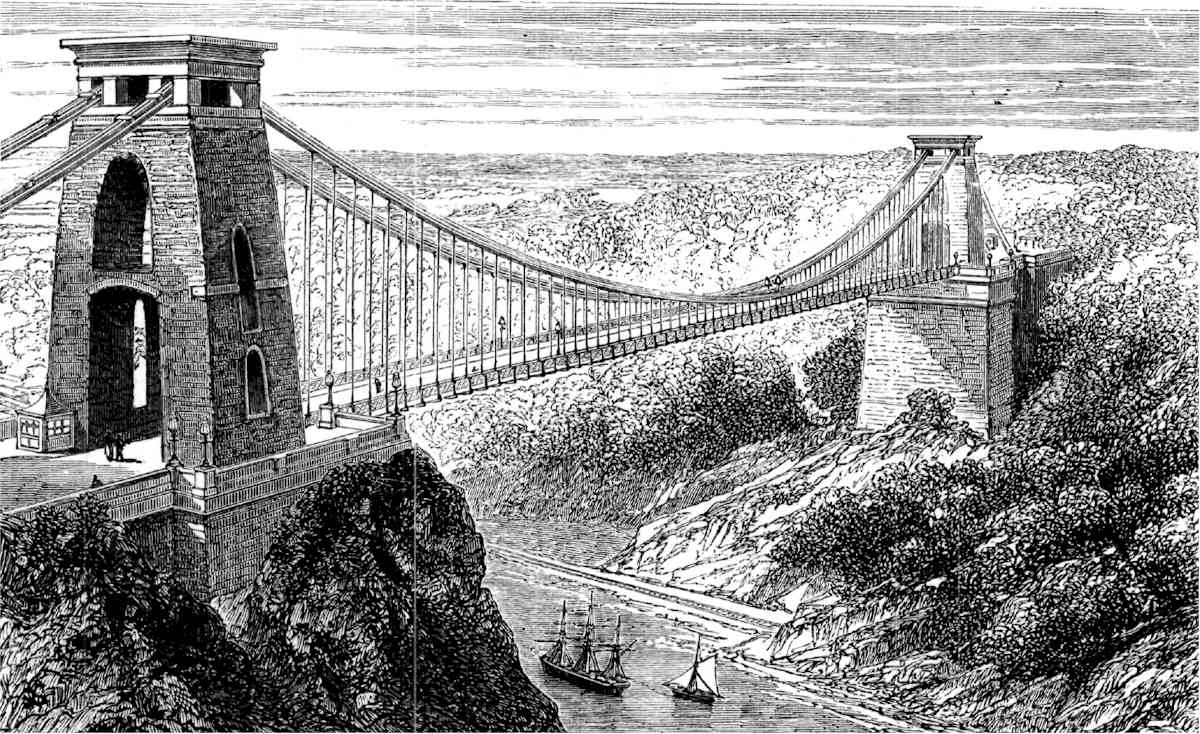
Clifton Suspension Bridge
The Clifton Suspension Bridge is a suspension bridge spanning the Avon Gorge and the River Avon, linking Clifton in Bristol to Leigh Woods in North Somerset. Since opening in 1864, it has been a toll bridge, the income from which provides funds for its maintenance. The bridge is built to a design by William Henry Barlow and John Hawkshaw, based on an earlier design by Isambard Kingdom Brunel. It is a grade I listed building and forms part of the B3129 road.
The idea of building a bridge across the Avon Gorge originated in 1753. Original plans were for a stone bridge and later iterations were for a wrought iron structure. In 1831, an attempt to build Brunel's design was halted by the Bristol riots, and the revised version of his designs was built after his death and completed in 1864.
Although similar in size, the bridge towers are not identical in design, the Clifton tower having side cut-outs, the Leigh tower more pointed arches atop a 110-foot (34 m) red sandstone-clad abutment. Roller-mounted "saddles" at the top of each tower allow movement of the three independent wrought iron chains on each side when loads pass over the bridge. The bridge deck is suspended by 162 vertical wrought-iron rods in 81 matching pairs.
The Clifton Bridge Company initially managed the bridge under licence from a charitable trust. The trust subsequently purchased the company shares, completing this in 1949 and took over the running of the bridge using the income from tolls to pay for maintenance. The bridge is a distinctive landmark, used as a symbol of Bristol on postcards, promotional materials, and informational web sites. It has been used as a backdrop to several films and television advertising and programmes. It has also been the venue for significant cultural events such as the first modern bungee jump in 1979, the last ever Concorde flight in 2003 and a handover of the Olympic Torch relay in 2012.
*********************************************************************************
Isambard Kingdom Brunel FRS 9 April 1806 – 15 September 1859, was an English mechanical and civil engineer who is considered "one of the most ingenious and prolific figures in engineering history","one of the 19th-century engineering giants", and "one of the greatest figures of the Industrial Revolution, changed the face of the English landscape with his groundbreaking designs and ingenious constructions" Brunel built dockyards, the Great Western Railway, a series of steamships including the first propeller-driven transatlantic steamship, and numerous important bridges and tunnels. His designs revolutionised public transport and modern engineering.
Though Brunel's projects were not always successful, they often contained innovative solutions to long-standing engineering problems. During his career, Brunel achieved many engineering firsts, including assisting in the building of the first tunnel under a navigable river and development of SS Great Britain, the first propeller-driven, ocean-going, iron ship, which, when built in 1843, was the largest ship ever built
"I am opposed to the laying down of rules or conditions to be observed in the construction of bridges lest the progress of improvement tomorrow might be embarrassed or shackled by recording or registering as law the prejudices or errors of today."
Isambard Kingdom Brunel
I hope you liked this new series if you do tell your friends and as always have a chilled day from the viking
Comments
Post a Comment