Hello ladies and gents this is the viking telling you that today we are talking about
Blessed with sunshine, a beautiful coastline, and interesting ancient monuments, Tarragona is a popular destination for those who live in and around Barcelona, 100 kilometers inland. This port town hugs the golden shores of Catalonia's Costa Daurada, the Golden Coast, and much of the city overlooks the Mediterranean. The gorgeous beach of El Milagro is within walking distance of the main landmarks.
Layer upon layer of history is everywhere, from the UNESCO-listed Roman ruins to the medieval alleyways and cobblestone streets and the Romanesque-Gothic cathedral. To soak up the quaint old-world ambience while enjoying a meal, head to El Serrallo — the fishing village that grew into the big city that is now Tarragona. In this atmospheric neighborhood, tourists can take a scenic stroll and enjoy delicious fresh seafood at one of the waterfront restaurants. For more ideas on things to see and do read our list of the top tourist attractions in Tarragona.
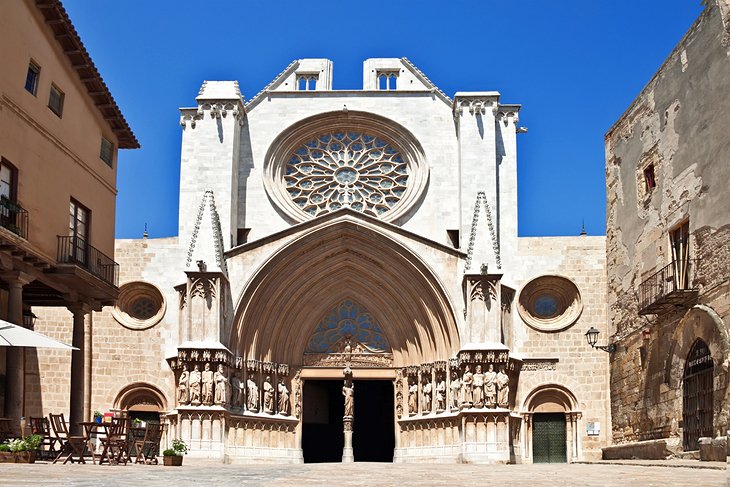
The magnificent Cathedral of Tarragona was built in the 12th century on the site of a 10th-century Moorish mosque, and its construction continued for centuries after. With its blend of architectural styles, the building is one of the most splendid examples of the transition from Romanesque to Gothic. The main facade features two 12th-century Romanesque portals and a stunning rose window with openwork tracery.
The interior, with three naves on a Latin-cross plan, creates an impression of great austerity. An octagonal dome over the crossing adds to the inspiring ambience, and in the transepts are exquisite stained-glass windows created in 1574. In the Capilla Mayor is a sensational 15th-century high reredos by Pere Johan. Crafted from polychromatic alabaster, the piece incorporates a trilogy of statues that represent the Virgin and Child, Saint Thecla, and Saint Paul.
Another artistic gem is the Gothic Archbishop's Sepulcher over the high altar. The Capilla de Santa María, dating from the 14th century, is also noteworthy for its vibrant medieval windows and a lovely retablo dedicated to the Virgin Mary painted by Francesc Olives in 1536.
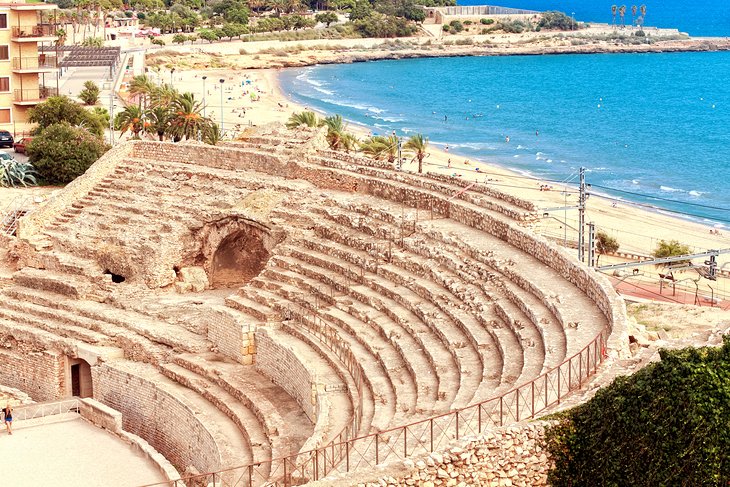
Vestiges of classical Roman buildings are dotted all over Tarragona, which after Mérida is the second most important archaeological site in Spain. The ancient Roman amphitheater is the most impressive of Tarragona's ancient remains. Built on a hillside overlooking the Mediterranean Sea, the amphitheater dates back to the second century AD during the reign of Emperor Augustus.
The immense stadium staged gladiatorial games, as well as other spectacles that entertained the Roman population. In its sloping rows of seats, the amphitheater could accommodate an astounding crowd of 12,000 spectators. The amphitheater was also the scene of the martyrdom of Bishop Fructuosus in AD 259. Beneath the arena are pits that were used for behind-the-scenes production of the events. In the center of the amphitheater are remains of a sixth-century Visigoth basilica and a 12th-century
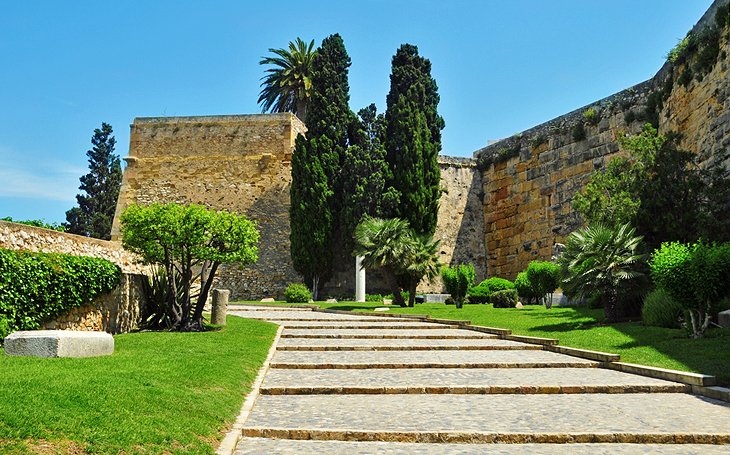
The Paseo Arqueológico begins where the Vía del Imperio (Imperial Way) runs into the Puerta del Rosario, an entrance gate that dates from around the fifth century BC. Shaded by cypress trees, the Paseo Arqueológico is a pleasant garden path at the base of the ancient Roman wall. It was built in the third to second century BC, and the wall originally enclosed the entire ancient town. Several sections are still intact, including one stretch that extends for 1,000 meters with heights ranging from three meters to 10 meters in places.
The amazing ancient defense structure is distinguished by its cyclopean stone masonry of massive irregularly shaped blocks. Local workers were employed to build the wall, and many of the stones bear Iberian masons' marks. Three towers of the wall have also survived: the Cabiscol Tower, Minerva Tower, and Arzobispo Tower. The Minerva tower is an excellent example of Roman architecture, and the Arzobispo Tower was altered during the Middle Ages. Tourists will enjoy soaking up the legacy of Tarragona's two-thousand-year history while appreciating scenic views from each end of the garden.
And as always have a chilled day from the Viking.
Top-Rated Attractions in Tarragona
Blessed with sunshine, a beautiful coastline, and interesting ancient monuments, Tarragona is a popular destination for those who live in and around Barcelona, 100 kilometers inland. This port town hugs the golden shores of Catalonia's Costa Daurada, the Golden Coast, and much of the city overlooks the Mediterranean. The gorgeous beach of El Milagro is within walking distance of the main landmarks.
Layer upon layer of history is everywhere, from the UNESCO-listed Roman ruins to the medieval alleyways and cobblestone streets and the Romanesque-Gothic cathedral. To soak up the quaint old-world ambience while enjoying a meal, head to El Serrallo — the fishing village that grew into the big city that is now Tarragona. In this atmospheric neighborhood, tourists can take a scenic stroll and enjoy delicious fresh seafood at one of the waterfront restaurants. For more ideas on things to see and do read our list of the top tourist attractions in Tarragona.
1. Cathedral
The interior, with three naves on a Latin-cross plan, creates an impression of great austerity. An octagonal dome over the crossing adds to the inspiring ambience, and in the transepts are exquisite stained-glass windows created in 1574. In the Capilla Mayor is a sensational 15th-century high reredos by Pere Johan. Crafted from polychromatic alabaster, the piece incorporates a trilogy of statues that represent the Virgin and Child, Saint Thecla, and Saint Paul.
Another artistic gem is the Gothic Archbishop's Sepulcher over the high altar. The Capilla de Santa María, dating from the 14th century, is also noteworthy for its vibrant medieval windows and a lovely retablo dedicated to the Virgin Mary painted by Francesc Olives in 1536.
2. Roman Amphitheater
Vestiges of classical Roman buildings are dotted all over Tarragona, which after Mérida is the second most important archaeological site in Spain. The ancient Roman amphitheater is the most impressive of Tarragona's ancient remains. Built on a hillside overlooking the Mediterranean Sea, the amphitheater dates back to the second century AD during the reign of Emperor Augustus.
The immense stadium staged gladiatorial games, as well as other spectacles that entertained the Roman population. In its sloping rows of seats, the amphitheater could accommodate an astounding crowd of 12,000 spectators. The amphitheater was also the scene of the martyrdom of Bishop Fructuosus in AD 259. Beneath the arena are pits that were used for behind-the-scenes production of the events. In the center of the amphitheater are remains of a sixth-century Visigoth basilica and a 12th-century
3. Paseo Arqueológico (Archaeological Walk)
The Paseo Arqueológico begins where the Vía del Imperio (Imperial Way) runs into the Puerta del Rosario, an entrance gate that dates from around the fifth century BC. Shaded by cypress trees, the Paseo Arqueológico is a pleasant garden path at the base of the ancient Roman wall. It was built in the third to second century BC, and the wall originally enclosed the entire ancient town. Several sections are still intact, including one stretch that extends for 1,000 meters with heights ranging from three meters to 10 meters in places.
The amazing ancient defense structure is distinguished by its cyclopean stone masonry of massive irregularly shaped blocks. Local workers were employed to build the wall, and many of the stones bear Iberian masons' marks. Three towers of the wall have also survived: the Cabiscol Tower, Minerva Tower, and Arzobispo Tower. The Minerva tower is an excellent example of Roman architecture, and the Arzobispo Tower was altered during the Middle Ages. Tourists will enjoy soaking up the legacy of Tarragona's two-thousand-year history while appreciating scenic views from each end of the garden.
And as always have a chilled day from the Viking.
Comments
Post a Comment