Hello ladies and gents this is the viking telling you that today we are talking about
WHALE SHARK
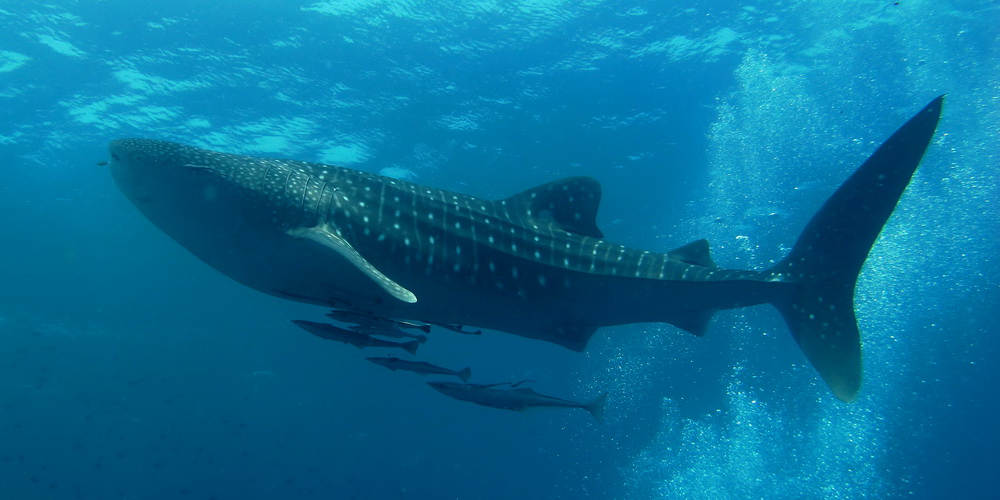
The whale shark (Rhincodon typus) is a slow-moving, filter-feeding carpet shark and the largest known extant fish species. The largest confirmed individual had a length of 18.8 m (62 ft). The whale shark holds many records for size in the animal kingdom, most notably being by far the largest living nonmammalian vertebrate. It is the sole member of the genus Rhincodon and the only extant member of the family Rhincodontidae, which belongs to the subclass Elasmobranchii in the class Chondrichthyes. Before 1984 it was classified as Rhiniodon into Rhinodontidae.
The whale shark is found in open waters of the tropical oceans and is rarely found in water below 21 °C (70 °F). Modeling suggests a lifespan of about 80 years, and while measurements have proven difficult, estimates from field data suggest they may live as long as 130 years. Whale sharks have very large mouths and are filter feeders, which is a feeding mode that occurs in only two other sharks, the megamouth shark and the basking shark. They feed almost exclusively on plankton and small fishes, and pose no threat to humans.
The species was distinguished in April 1828 after the harpooning of a 4.6 m (15 ft) specimen in Table Bay, South Africa. Andrew Smith, a military doctor associated with British troops stationed in Cape Town, described it the following year. The name "whale shark" refers to the fish's size, being as large as some species of whales, and also to its being a filter feeder like baleen whales.
The whale shark inhabits all tropical and warm-temperate seas. The fish is primarily pelagic, living in the open sea but not in the greater depths of the ocean, although it is known to occasionally dive to depths of as much as 1,800 metres (5,900 ft).
Seasonal feeding aggregations occur at several coastal sites such as the southern and eastern parts of South Africa; Saint Helena Island in the South Atlantic Ocean; Gulf of Tadjoura in Djibouti, Gladden Spit in Belize; Ningaloo Reef in Western Australia; Kerala, Lakshadweep, Gulf of Kutch and Saurashtra coast of Gujarat in India; Útila in Honduras; Southern Leyte; Donsol, Pasacao and Batangas in the Philippines; off Isla Mujeres and Isla Holbox in Yucatan and Bahía de los Ángeles in Baja California, México; Maamigili island, Maldives; Ujung Kulon National Park in Indonesia; Cenderawasih Bay National Park in Nabire, Papua, Indonesia; Flores Island, Indonesia; Nosy Be in Madagascar; off Tofo Beach near Inhambane in Mozambique; the Tanzanian islands of Mafia, Pemba, Zanzibar; Gulf of Tadjoura in Djibouti, the Ad Dimaniyat Islands in the Gulf of Oman and Al Hallaniyat islands in the Arabian Sea; and, very rarely, Eilat, Israel and Aqaba, Jordan.
Although typically seen offshore, it has been found closer to land, entering lagoons or coral atolls, and near the mouths of estuaries and rivers. Its range is generally restricted to about 30° latitude or lower. It is capable of diving to depths of at least 1,286 m (4,219 ft), and is migratory. On 7 February 2012, a large whale shark was found floating 150 kilometres (93 mi) off the coast of Karachi, Pakistan. The length of the specimen was said to be between 11 and 12 m (36 and 39 ft), with a weight of around 15,000 kg (33,000 lb).
In 2011, more than 400 whale sharks gathered off the Yucatan Coast. It was one of the largest gatherings of whale sharks recorded. Aggregations in that area are among the most reliable seasonal gatherings known for whale sharks, with large numbers occurring in most years between May and September. Associated ecotourism has grown rapidly to unsustainable levels.
And as always have a chilled day from the Viking.
Comments
Post a Comment