Hello ladies and gents this is the Viking telling you that today we are talking about
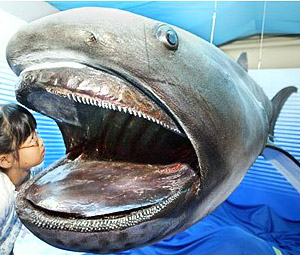
THE MEGAMOUTH SHARK
The megamouth shark (Megachasma pelagios) is a species of deepwater shark. It is rarely seen by humans and is the smallest of the three extant filter-feeding sharks alongside the whale shark and basking shark. Since its discovery in 1976, few megamouth sharks have been seen, with fewer than 100 specimens being observed or caught. Like the other two planktivorous sharks, it swims with its enormous mouth wide open, filtering water for plankton and jellyfish.
It is distinctive for its large head with rubbery lips. It is so unlike any other type of shark that it is usually considered to be the sole extant species in the distinct family Megachasmidae, though suggestion has been made that it may belong in the family Cetorhinidae, of which the basking shark is currently the sole extant member. Researchers have predicted the feeding patterns of megamouth sharks in relation to the other two planktivorous sharks; the three plankivourous sharks have ram feeding in common, as it evolved from ram feeding swimming-type ancestors that developed their filtering mechanism to capture small prey like plankton.
In addition to the living M. pelagios, however, two extinct megamouth species – the Priabonian M. alisonae and the Oligocene–Miocene M. applegatei – have also recently been proposed on the basis of fossilized tooth remains. An early ancestor of the recent species Megachasma pelagios was reported from the early Miocene (Burdigalian) of Belgium. However, the Cretaceous-aged M. comanchensis has been recently reclassified as an odontaspid shark in the genus Pseudomegachasma, and is in fact unrelated to the megamouth shark despite similar teeth morphology.
The appearance of the megamouth is distinctive, but little else is known about it. It has a brownish-black colour on top, is white underneath, and has an asymmetrical tail with a long upper lobe, similar to that of the thresher shark. The interior of its gill slits are lined with finger-like gill rakers that capture its food. A relatively poor swimmer, the megamouth has a soft, flabby body and lacks caudal keels. The megamouth is considerably less active than the other filter-feeding sharks, the basking shark and the whale shark. The megamouth has a stout body and a long, wide bulbous head.
Megamouths are large sharks, able to grow to 5.49 metres (18.0 ft) in length. Males mature by 4 m (13 ft) and females by 5 m (16 ft). Weights of up to 1,215 kg (2,679 lb) have been reported.
As their name implies, megamouths have a large mouth with small teeth, and a broad, rounded snout, causing observers to occasionally mistake megamouth for a young orca. The protruding inside of the upper lip is a brilliant silvery-white, which is very visible when the mouth is open. This lip was initially thought to be possibly embedded by luminous photophores when the first shark were examined in the early 1980s, which may act as a lure for plankton, while the team examining the second shark in the mid-1980s instead proposed that the lower lip might glow with the white band used as a reflector of sorts, but neither theory has been proven.
This white band is present in both sexes and could be either a feeding mechanism or possibly be used as a means of identifying other individuals of megamouth sharks. Their mouths can reach up to 1.3 m (4 ft 3 in) wide. Megamouth sharks have up to 50 rows of teeth in their upper-jaw and up to 75 rows of teeth in their lower-jaw.
And as always have a chilled day from the Viking
Comments
Post a Comment