Hello ladies and gents this is the viking telling you that today we are talking about
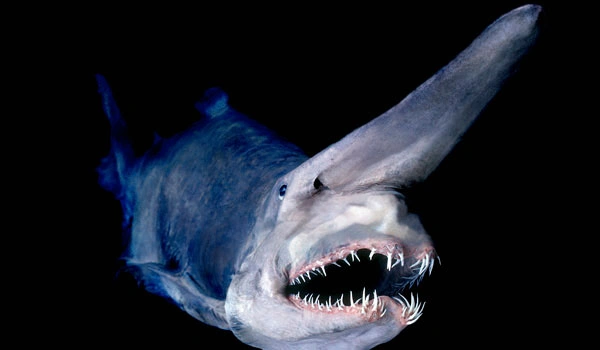
THE GOBLIN SHARK
The goblin shark (Mitsukurina owstoni) is a rare species of deep-sea shark. Sometimes called a "living fossil", it is the only extant representative of the family Mitsukurinidae, a lineage some 125 million years old. This pink-skinned animal has a distinctive profile with an elongated, flattened snout, and highly protrusible jaws containing prominent nail-like teeth. It is usually between 3 and 4 m (10 and 13 ft) long when mature, though it can grow considerably larger. Goblin sharks inhabit upper continental slopes, submarine canyons, and seamounts throughout the world at depths greater than 100 m (330 ft), with adults found deeper than juveniles.
Various anatomical features of the goblin shark, such as its flabby body and small fins, suggest that it is sluggish in nature. This species hunts for teleost fishes, cephalopods, and crustaceans both near the sea floor and in the middle of the water column. Its long snout is covered with ampullae of Lorenzini that enable it to sense minute electric fields produced by nearby prey, which it can snatch up by rapidly extending its jaws. Small numbers of goblin sharks are unintentionally caught by deepwater fisheries. The International Union for Conservation of Nature (IUCN) has assessed it as Least Concern, despite its rarity, citing its wide distribution and low incidence of capture.
The goblin shark has a distinctively long and flat snout, resembling a sword blade. The proportional length of the snout decreases with age.[18] The eyes are small and lack protective nictitating membranes; behind the eyes are spiracles. The large mouth is parabolic in shape. The jaws are very protrusible and can be extended almost to the end of the snout, though normally they are held flush against the underside of the head. It has 35–53 upper and 31–62 lower tooth rows.
The teeth in the main part of the jaws are long and narrow, particularly those near the symphysis (jaw midpoint), and are finely grooved lengthwise. The rear teeth near the corners of the jaw are small and have a flattened shape for crushing. Much individual variation of tooth length and width occurs, as for whether the teeth have a smaller cusplet on each side of the main cusp, and regarding the presence of toothless gaps at the symphysis or between the main and rear teeth. The five pairs of gill slits are short, with the gill filaments inside partly exposed; the fifth pair is above the origin of the pectoral fins.
The body is fairly slender and flabby. The two dorsal fins are similar in size and shape, both being small and rounded. The pectoral fins are also rather small and rounded. The pelvic and anal fins have long bases and are larger than the dorsal fins. The caudal peduncle is flattened from side-to-side and lacks keels or notches. The asymmetric caudal fin has a long upper lobe with a shallow ventral notch near the tip, and an indistinct lower lobe.
The soft, semitranslucent skin has a rough texture from a covering of dermal denticles, each shaped like a short upright spine with lengthwise ridges. Living sharks of this species are pink or tan due to visible blood vessels beneath the skin; the color deepens with age, and young sharks may be almost white. The fins' margins are translucent gray or blue, and the eyes are black with bluish streaks in the irises. After death, the coloration fades quickly to dull gray or brown.
Adult sharks usually measure between 3 and 4 m (9.8 and 13.1 ft) long. However, the capture of an enormous female estimated at 5.4–6.2 m (18–20 ft) long during 2000 showed this species can grow far larger than suspected previously. The maximum weight recorded is 210 kg (460 lb) for a 3.8-m-long shark
Comments
Post a Comment